Projects 2010 > Fortnight > Journal
I learned an interesting fact today. One that I feel I should have known but did not. I learned this fact whilst watching my boyfriend unleash all manner of terror on the city of Liberty in ‘Grand Theft Auto’ …he has asked me to mention the fact that he is a former Tekken tournament winner and is an accomplished Super Street Fighter IV player also, as he is embarrassed that you may judge him on his choice of experience. Pffff. Gaming ego… During this adrenaline fuelled frenzy, he managed to communicate that this game is referred to as a ‘Sandbox’ game… for the first time since the x-box was switched on this morning, he had my attention.
So, in a video gaming context, Sandbox is a term which is applied to a particular form of game environment in which you can roam freely and explore without purpose, but which can also have side quests that, should you choose to do them, can allow you access to new and exciting levels. With the example of Grand Theft Auto, the more attention you draw to your gaming self, the more notorious you become and the higher your status. The higher your status within the game, the more ‘stuff’ you are awarded: bigger guns, nicer cars, better looking women and an army chasing your tail instead of, say, a community policeman. This notion of collecting information, completing or fulfilling something in an attempt to move forward (or sideways) or further in to a world is something, which I feel I can relate to. Real life is a constant negotiation and reasoning of what fits where and what has the greater or lesser ramification to a particular situation. As a company, we ‘make’ in the same way: striving towards an end point but always willing to explore all avenues of possible interest or intrigue (sadly as an individual, I don’t always have a great enough sense of awareness to consider my own movements and decisions as logically as I would were I sitting on the outside watching myself, with a can of something chilled at my side and a controller in my hand!) We’ve had an interesting time of it these last few weeks in our respective lives. I have been living on Virgin trains back to back, Wes has been in lock down engaging only with Kant and anyone else who has challenging theories on beauty and the sublime (any takers?!) Peter has been clocking up the air miles as best he can whilst considering cognitive science and the creation of space within our heads and Rachel has been investigating the NHS from the inside…Not to mention developing The Fortnight Project throughout.
So today’s epiphany has enlightened me twofold:
1. I always understood the connection of the title of the commission to an actual sand box; play to our hearts content within a confined environment whilst engaging in a non-linear fashion, but I wasn’t aware that the term ‘Theatre Sandbox Commission’ had greater affiliations to the gaming world (and more specifically, video games).
2. As I mentioned at the event last week in Bristol, we have been actively avoiding the use of gaming rhetoric in an attempt to immerse ourselves in the making of theatre as opposed to a game with theatrical elements. We have intentionally deviated from possible ‘task/reward’, ‘End of level bosses’ and ‘ranking system’ structures as featured in gaming. This, we are pleased to announce, is going well and we are all very excited about the developments we’ve made. However, having considered more thoroughly the structure of a sandbox game, it would appear that whilst avoiding creating a theatre ‘game’, we have been immersed steadfastly in one. It’s as though some external observer has in fact been playing the game ‘Proto-type Theater Sandbox Commission 2010: Modern Warfare’ in which Peter, Rachel, myself and Wes are all ‘selectable’ pawns.
Yes, in an attempt to create the non-gaming ‘Fortnight Project’ we have been engaging in the real world’s real life sand box, unwittingly completing quests the rewards of which have been in the form of experiences. These have informed and developed our understanding of what we are creating in ‘Fortnight’. The ‘game’ of reality informing the theatrical experience. This is the objective of the game that we have found ourselves in.
One of our objectives with the Fortnight project has always been to create a multi platform, multi narrative, multi media, multi city performance which unfolds in real time for its participants, and one of the focuses for us has been the relationship between the global and the local. In our first blog, Peter discussed having to head from the UK to the US at very short notice. At the time the situation threw us all in to emergency mode, quickly reallocating workloads and rearranging travel plans and adapting to the unexpected. Despite dealing with the logistics swiftly, Peter also had to contend with the loss of a family member and with being so far from home during a family bereavement. Previously we had discussed what it means to be separated by geography but relocated through the use of different forms of pervasive media. All of the theories which we’d formed in relation to that changed for Peter as he stood on one side of the Atlantic (a seven hour flight away from his family) wishing himself over to the other side. This forced us all to reconsider what communication is and why and when we have it and what form is suitable or in fact necessary. A picture message versus a Skype message versus a telephone call versus a face-to-face discussion versus ‘being there’ versus quietly, just holding someone. We learned that sometimes, geographical closeness is necessary and so is silence. This journey of Peter’s had a deep seated impact in our understanding of what global and local mean to us and how this new found understanding can help us to move forward with the project in a more enlightened way. As it transpired, this was the first mission.
Following the last peer event at the Watershed, Rachel became very unwell. Let’s say she ‘uncovered a portal’ that led us to some alternative content, one which initially neither of us wanted to experience. Instead of an early night, we encountered an out of hours doctor. Two Paramedics (who were more overwhelmed by the doctor’s lovely handwriting than Rachel’s ‘situation’). An ambulance (this was less exciting for Rachel than it was for me. I had never been in an ambulance before and was, albeit witnessing Rachel thrashing about like she needed exorcising, enjoying it a little bit.) and finally the surgery department of Bristol Royal Infirmary. First bed on the right, Ward 14 C, Level 6. This was to be the level on which we encountered our next mission and I was alerted to this by the fact that Rachel was given a barcode, QR coded ID bracelet. A complete give away!
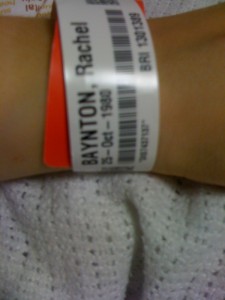
Rachel's ID band.
As this mission was set in a hospital with levels and an architectural similarity to games with which I am more familiar (Pac-Man for example) I feel obliged to visualise and describe it in those terms…
It transpired, after much deliberation between the hospital staff, that Rachel’s appendix needed to be removed and we both had an opportunity to level up. Rachel had to engage in side quest ‘Appendix removal’ and I had to engage in side quest ‘remain in Ward 14 C’. Both quests had their difficulty ratings. Rachel’s appendix may not have been the cause of her crippling pain in which case she would have to undergo further investigative surgery and remain on level 6. I could leave Level 6 at any given point in time, but if I chose the wrong exit, I could forego entry back in to level 6 and find my only option to be returning to level 1 by the stair case. Tricky one. After a couple of hours on watch in Ward 14 C, I was informed that Rachel’s appendix had been successfully removed. She was remaining on level 6. Never one to turn my back on a challenge, I stuck it out on Ward 14 C for another 3 hours to await the return of my comrade and I’m glad I did, for that’s where I found the additional content required to complete mission 2.
The last room on the right in Ward 14 C, housed 4 unlikely characters. A 68 year old woman who had fallen and broken both wrists whilst smashing her face on the pavement. She couldn’t hold anything and was very thirsty. A 48 year old woman called Tracy, who had crippling stomach pains. She had been given the wrong dose of Ritalin and was finding it very difficult to communicate calmly with the nursing staff. A 29 year old woman also suffering from crippling stomach pains, experiencing her first night without either of her children who are now aged 8 and 6 years respectively. Over the course of one evening in the ward, the four of us were bound together on a waiting mission (no more 1980’s style gaming lingo, I promise!) for the only talkative patient to return from surgery; (d) Miss Rachel Baynton. During our wait I began chatting with Tracy. She mentioned that she is autistic and was embarrassed at having verbally attacked each of the staff members but that she couldn’t control her behaviour due to the level of medication mixing with her Ritalin. We left the room to get some air and managed to find some straws, allowing the broken wristed lady to sip water enough to take her medication. The three of us managed to convince the lady who’s children were too young to visit her on the ward, to pull her bed curtain open and have some tea and toast with us. We began sharing photographs on phones and watching movies on an iPod and discussing pain thresholds and introducing friends and family as they came and went during visiting hours. We discussed theatre and what it was. Tracy explained that for her theatre is something that you must sit down and watch. I asked her why. She replied that ‘that’s just the way it’s always been’ I explained how the ‘Fortnight Project’ will be theatre which unfolds in real time in real places as opposed to in a theatre with the auditorium lights switched safely off. She seemed satisfied that this was plausible (which was a huge relief to me!) and that she’d like to do it. We mused over what we each considered to be the highlights of Bristol and although each of us said something different, the commonality emerged that each highlight of Bristol was inextricably linked to a moment of nostalgia. We were making memories there and then, sat on itchy hospital blankets eating anaemic toast and overly sugary jam. We formed a bond in that short while that Rachel was unconscious, ‘picking up health’. We formed a community.
Jo Reid spoke eloquently about creating communities at the last peer event, reminding us that ‘test groups’ are not just for Christmas, they’re for the life of the project; that they should be involved before the work begins to allow them an insight in to and ownership of what is being created, and that the best way to ensure your model is being tested properly, is knowing that the participants have developed a personal investment in what you are making with no requirement of a monetary incentive or indeed ‘a cup of tea and a biscuit’ (or in my case a cup of tea and overly pale toast!) Something that we failed to consider is the way in which we manage ourselves succinctly in to small groupings and communities when left to our own devices. That we can encourage the making of communities but that they will always find a way of creating themselves, by finding commonality that joins people together. In terms of development of our project, it had been an eye opener to encounter four extremely different women with very different outlooks on life, all laid up in hospital sharing an experience which they would rather not be experiencing. Communities will start to form themselves in the most unorthodox manner and context and I’m excited to embrace them.
So, ‘Proto-type Theater Sandbox Commission 2010: Modern Warfare’ is already underway it would seem, without us having realised it, informing the development of our non-gaming theatre project. We’ve reconsidered our notion of the global and the local, and our sense of community has been reignited and reconfigured with the additional swift reminder that the phenomenon of ‘circumstance’ can help to immerse our participants more fully in to our project. My only concern remains thus: Who’s next in line for a deviation from the trajectory? Because its looking like its me or Wes. And considering that I’m off to Bristol next week (from where our missions seem to be emerging) and Wes is not, then it’s going to be me and I’m not sure that I can work through another transatlantic trip or stay in hospital. Be kind, gods of the game, and give me a cheat sheet or something?