Projects 2010 > Fortnight > Journal
Whenever Proto-type has made a show where something that seems external to the process happens suddenly, I am reminded of why it is that I make theatre in the first place: to record, dissect, and understand what it means to be alive at this particular moment in time (and how fleeting life really is).
Don’t worry. This will make sense soon.
It has been a busy month of work for us at Proto-type and an eventful first two weeks of the Theatre Sandbox Commission. We applied with a project that was called cityEscape and over the course of the shortlisting process the title changed to Fortnight. From the beginning we knew we wanted to create an experience that would unfold for its participants over the course of two weeks time – and that it would happen in the ’space of daily life’ via the technologies we use everyday. This meant that instead of coming to the theatre at a specific time, participants would purchase a ticket, giving over a set of contact details to us including a mobile phone number, postal address, email address and a few other bits of information so we could send content directly to them. We also thought the piece would be somehow about the idea that the ‘local’ has shifted dramatically over the past decade with the advent of high-speed internet and mobile technologies (like cell phones, GPS, RFID, etc). Originally we thought the piece had something specific to say about cities but the more we developed the concept, and toyed with tiny experiments in content, the more we realised that might be a misnomer. So… the title changed. Fortnight it is.
Over the past several weeks, we’ve managed to run a three-day test of the project in Lancaster with help from Nuffield Theatre Lancaster, the Storey Creative Industries Centre (our home) and a few willing test-subjects, we’ve been introduced to and met with our lovely host venue for this commission (the Bristol Old Vic), we’ve met the other participants (and this is where ‘real’ life bled into the process) and we’ve made headway on developing some of the project’s specifics. A lot of activity over only a few short weeks – especially as we are now in London performing our touring piece Third Person: Bonnie & Clyde Redux at Soho Theatre. My mother always told me that an idle mind is the devil’s playground (bet she regrets that now), and Proto-type seem to have ingested that mantra whole-heartedly. We are never idle…
The test-run of the project revealed a lot about the piece. Here is how it worked (spoiler alert – this may ruin the eventual final piece for you – skip this paragraph and the next if you don’t want it to be ruined. Skip to <SPOILER OVER> to be extra safe.): On the first day at midnight, we slipped letters through the letterboxes of all the participants. Two letters actually. One which said ‘open me’ and the other which said ‘don’t open me yet’. In the one that said ‘open me’ was a letter. It looked like this:
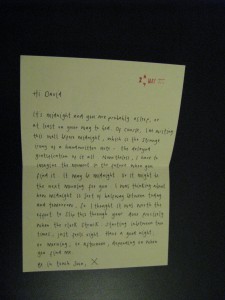
On the back was a URL to fortnightproject.com – a website where the twitter feed for the test was running. If you visit it now, you’ll see the last few tweets from the test. In the other envelope was a USB stick. If a participant opened it and put it into their computer they would find a password protected file. At around dinnertime on day one, everyone received a text message from us that said “It’s getting late; you are probably eating dinner or thinking about it. Did you get something at the market yesterday to cook? I hope you didn’t open the envelope yet. Thats for tomorrow. In the meantime, remember this: AW4” (the market day in Lancaster is on Weds, and this text was sent on a Thurs). The next day at 8am, another text came through that invited the participant to go to a specific post code to pick up a ‘little surprise’ if they had time. This was our way of dealing with what we are calling ‘optional content’ for keen beans. If they went to the postcode they would have received a little packet of birdseed (and a map to where to feed the birds, in the ideal world although we didn’t get to this for the test). At noon, a missed call would come through. If they called the number back they would hear a voicemail saying that the person was out in the garden and that something was ‘happening again’. At 8pm, an email was sent that explained a few of the thematic strands (without giving that much away really) and provided the last piece of the password. It also invited the participants to open the USB stick and watch the video. I won’t tell you what the video is, because we may use some version of it in the ‘real’ project, but suffice to say it filled in some of the details to a ‘narrative’ relating to the strange appearance of a foreign fruit in a hidden garden in Lancaster. It also raised some questions about where ‘here’ is and what it means to be ‘lost’, ‘local’, or to be in touch at all. The next day, an e-vite was sent out to a ‘garden party’ (which would have taken place in the hidden garden the video referred to – although for this test we only did three days, so it didn’t happen).
Through the test we learned a lot – most of all that we have a lot more work to do deciding how important narrative is, where we are going in terms of using more complex technology (and how much of a barrier this will be to non-techies joining in) and how we want to tease out our thematic around the ‘local’.
<SPOILER OVER>
A number of our questions became clearer after the two-day launch event for the theatre sandbox participants which happened in early July at the Pervasive Media Studio in Bristol. Things also became more complicated in a very personal way. Whenever people asked me about this project I would explain that we were interested in what the local was anymore now that it is possible to have a network that is dispersed over large geographic distances… and now that many of us (myself included) are foreigners in our home. I would talk about the way that my ‘local’ includes people from NY, Florida, Glasgow, Lancaster and Wisconsin even though I live in Manchester. And, to a degree I think this is still true – local for me has slipped from being centred on geographic proximity to being about proximity in a wider sense (as enabled by technology). For instance, I work with a dance company in NY as a dramaturg even though I live in Manchester. We rehearse over SKYPE (and have been for three years) in order to create our pieces. For me, those dancers are just as much local to me as the strangers I see on the streets in Manchester – perhaps even more so since I actually engage with the dancers. This is of course a problematic way of thinking about things. On the first night in Bristol, the problem of this conception of the local made itself apparent when I received a call from my partner about a death in our immediate family. Although in some ways it was not a surprise (as he had been ill for many years) it was a complete shock since he had always bounced back from any of his other brushes with fate. Why this is relevant here is that in the moment of the call I realised how terrible it feels to have a constructed sense of the local (my local as created by SKYPE, email and mobile phones) ruptured. In the moment of the call I knew that my partner and I could not just get in the car to console our family. We couldn’t even hop a quick flight to their home. We were literally stranded at the other end of the world for a period of 48 hours as we reconfigured our lives to travel back to the middle of America. Although we would have been incredibly sad about the news regardless of where we were when we heard it, I know that not being able to be physically close to our family made it even worse. We had to cry alone, as dramatic as that sounds (apologies).
Because of this rupture of the local, as I have begun to think of it, I had to fly to the states and could not be at the next scheduled working session for Fortnight. The rest of the company worked without me – except for an occasional comment on a blog post and one long SKYPE call. They developed several versions of a first week of the project which we are now developing together in London during the daytime before our evening shows of Third Person. The shift in my sense of the local, though, has started to filter its way into the piece. Its made the questions we are exploring feel more real. Hopefully over the next few months we will begin to answer some of those questions – or at least refine them to more manageable ones. In the meantime, I am looking forward to experiencing the next fortnight in London for the run of our show and will be looking for clues in the streets of Soho for what it means to be here now.
This post is also over on Proto-type’s company blog. More on the company is available on our website.