Projects 2010 > You're So Happy I Want To Die > Journal
Our recent residency in Birmingham culminated in two test performances in front of audiences made up of deaf and hearing people.
Their feedback really helped reinforce my beliefs about what artistic captions should be like. More on that later, but first a bit of background on the build up to the tests.
It was crucial to get deaf people’s feedback about our captioning experiment. Much of our efforts in the first week were about going out into Birmingham’s deaf community, introducing ourselves and marketing the test shows. We also asked people to fill in questionnaires, the results of which we will publish soon.
But we couldn’t just march into deaf clubs and hand out questionnaires, (as a deaf person myself I know how annoying it can be to be ‘researched’) we had to make friends and offer something in return. And so we gave talks, ran drama workshops, and hung out in deaf clubs chatting to people. The legwork paid off and we even had deaf people traveling from Wolverhampton to see the tests. Big up to Brummies Ruth, OJ, and Alison who very generously helped to spread the word about our test shows.
(Me and Gemma method costume shopping in Tamworth)
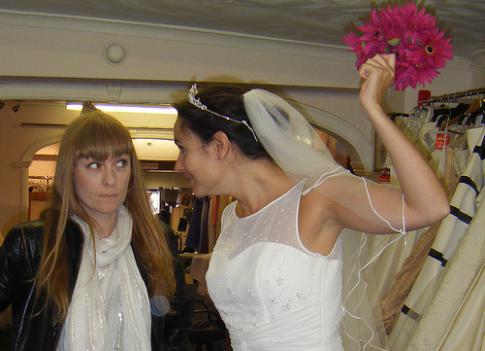
The upshot is we have a brand new audience of captioned theatre aficionados in the West Midlands. One young deaf actress told me she was so excited to discover our test show because captioned shows are rare in that part of the country. After the second test and Q&A everyone stayed back to do vox pops for our Theatre Sandbox documentary. We were also lucky enough to have BBC2’s See Hear film our first test (airs later this month).
Some of the audience feedback was quite critical. We tried to cram as much interactive captioning as we could in just one ten minute scene, which meant we ended up overloading the captions with the effects we were testing. This meant the graphics became a distraction from the acting.
Although there is some information a deaf person cannot get from normal captions, the golden rule from my own deaf perspective is always: the best access is the type you don’t notice. The more you consciously notice and focus on the captions, the less you see the emotions conveyed by the actor. This rule works for both deaf and hard of hearing people. But how to marry that rule to our company’s need to integrate the captions into the design of the show?
Despite being completely knackered at the end of our two week stay, we had a very enjoyable debrief meeting with our computer programmer Yousif and came up with some cracking ways to do this more cunningly. We will continue to tinker with prototypes over the next two months and hope to revisit Birmingham to show the results to our discerning new audience.



Comments