Projects 2010 > Living Film Set > Journal
It’s been a hyperactively busy and inspiring fortnight of activity in the Analogue camp – I’ll do my very best to try and unpack it…
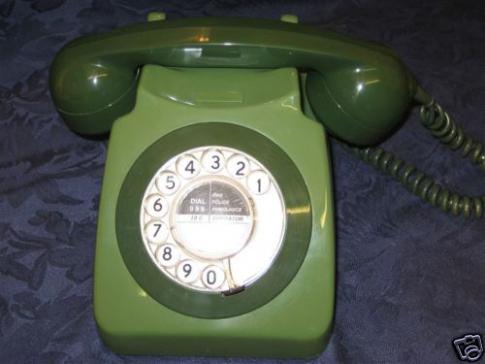
…but before I do, a slight tangential aside; the 1980’s rotary dial telephone we ordered arrived this week. This is the phone the participant will receive a phone call from, and it’s just like the one we used to own in 1985 – it’s made me quite nostalgic! Ahem, back to the main thrust of the blog…
Intellectual Exchange
We began the journey of these last few weeks with the unique opportunity to hear about the parallel journeys of the other commissions at Watershed on Monday 2nd August. The diversity of approach and evolution of each of the ideas over the last month through experimentation, testing and trial and error has been fascinating. Unquestionably there were processes that resonated closely with our own experiences; our discussion with John McGrath and Proto-type was particularly useful in identifying, with fresh eyes, aspects of our project that are focused (and perhaps even more importantly, areas that require more clarity in terms of the experience we want to create for an audience). Jo Reid, Creative Directer of Calvium, gave a really insightful discussion concerning testing ideas, collaborating with others and methods of eliciting feedback from participants of technology driven performance experiences. For us, the complexity of synthesising technical discovery and satisfying narrative journey is one that Hannah and I come back to on a more or less daily basis (!). Herein lies the most significant Catch-22 problematic with the commission; start with the technology, and you risk creating an experience merely about the functionality of the technology and what it can do. Start with dramatic narrative, and the technology could become a mere cosmetic add-on to an experience that could well exist without it. But of course, we all must start somewhere! We’ve taken the latter route, which is not so much a choice but an inevitability since we are using autobiographical source material as the foundation for the work – the drama is already there (our research over these last few weeks has provided us with more content than we can possibly use), so for us the focus must now be on investigating technologies and synthesising the technological operation/interactivity with an emotional narrative journey for a participant. Seamless synthesis is the aim..!
Whilst on our lunch break at the Pervasive Media Studios, Becca Gill of Mercurial Wrestler, very generously allowed us to take a closer look at their recent creation, The Magician’s Desk, peering ‘behind the green curtain’ as it were, to see how this sensor driven intervention operated. Creative Technology Research Associate at the Pervasive Media Studio, Dan Williams very kindly explained the technology involved; (*Spoiler alert*) namely Phidgets (”plug and play” building blocks for low cost USB sensing and control from your PC) controlled via a laptop. We are interested in experimenting with this technology, as triggers are a logical way to build a sequential experience in which audience interaction unveils both narrative information and prompts (that direct the user to the next trigger etc). We are interested particularly in experimenting with user interaction triggering mini-projection onto scale models (this ability to change the appearance of the surfaces of models digitally, fits well with the notion of revisiting and revising the memory of a place). This is an area of practical investigation over the coming month, and we’ll keep you posted on the outcome of these experiments.
Surface Tables
On Tuesday 3rd August, immediately after our Bristol visit, Hannah and I went on a field trip to Microsoft Research Labs in Cambridge with Theatre Sandbox advisor Kenton O’Hara. The visit began by meeting Shahram Izadi and the rest of the research team. We spoke about our Sandbox commission (using this blog as our principal tool to communicate the journey of the project thus far). We then had the chance to hear about the research projects at the Lab. Amongst the technologies in development, we were fortunate enough to see and demonstrate first-hand the following; Microsoft Second Light (a type of surface computer that opens up the interaction space above and beyond the display), Surface tables (multi-touch computers that respond to natural hand gestures and real-world objects, helping people interact with digital content in a simple and intuitive way), VPlay (demonstrated for us by Researcher Stuart Taylor, VPlay is designed to support the practice of VJing, or live video mixing) and Surface Physics (allowing interactions with digital objects to simulate the physics of the real-world). The links I’ve included here will take you to video demonstrations of each of these technologies, whilst additional information is succinctly outlined on Shahram’s research pages on the Microsoft website.
We are continuing to consider the potential of some of these technologies to our existing ideas. Surface tables present some fascinating possibilities, since what appears onscreen can appear in reaction to three dimensional objects placed on the surface – in our case this would be scale models with barcodes strategically positioned on the bottom (which would tell the computer system what to trigger onscreen). Of course we again face a series of Catch-22 paradoxes – namely the length of time it takes to develop the onscreen content. It would be difficult to have anything in place in time for our testing on 29th September. Additionally, this technology comes at a high price with an understandable amount of negotiation with corporate legal teams before deployment of the equipment is given the thumbs up. Nonetheless we continue to jot down ideas, and the Microsoft Research team have been wonderfully open to discussion and are planning to join us for testing at The Junction on 29th September (with whatever tech we have managed to get in place by this time), so there is an ongoing conversation that we are interested in continuing.
We have begun to develop a storyboard plotting the narrative journey of the participant – much of our activity over the next fortnight is developing this further so I’ll delay discussing our ideas for the framework of the narrative until it’s a little further progressed (this would be the not so subtle hook to get you to come back and read blog number 4 which will be epic – passing the baton (not to mention any weight of expectation I’ve created) back over to you Han!).
Super Glue
Oscillating between our research into high-end tech, I must not neglect to talk a bit about the tactile scale maquettes that we have begun making also.
The images of paper models that we have posted here over the past month have served well as templates to begin working from slightly more robust materials – this is necessary because at times we are planning on asking the audience to physically interact with the models (needless to say more resilient materials are therefore essential without losing the kindergarten aesthetic properties of the paper counterparts)
We have been gathering materials from 4D, Aldgate East – a shop specialising in model making materials for architects, designers and hobbyists. Beyond supplying materials, they also offer useful tips and advice in person and online model making guides. So far we are experimenting using finnboard and sheets of cherry wood, and have begun ordering electrical items such a scale lighting from dolls house specialists and Model Railway manufacturers.
I have also experimented with creating nets of my childhood home editing photographs we took on our field visit with Adobe Photoshop, then folding these nets into three dimensions:
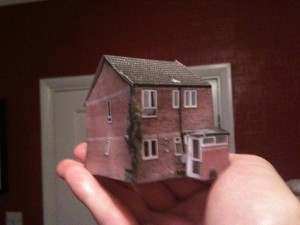
Here’s a basic model we made this week at 1:120 scale
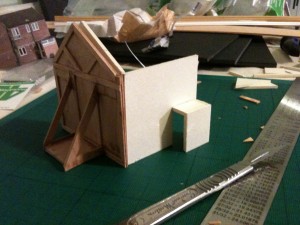
Above is a more robust model of the facia of the house, complete with exposed film set timber supports (the idea is that all the scale models are representative of film scenery from the neighbouring Shepperton Studios)
We plan to continue working on these models in the coming weeks in order to be able to take them to the Pervasive Media Studio where we will be working on 31st Aug/1st Sept. During this period we will be experimenting with different ways of interacting with the models to trigger particular effects/prompts. This precedes an intensive period of working on location throughout September at our host venue, The Junction (and we very much look forward to being in the building).
Thanks for reading, feel free to comment and we’ll post more about the process soon
Liam (and Hannah)
N.B: For more info about what we do please come and visit us, or follow our stream of consciousness on Twitter (!)



Comments