Projects 2010 > Living Film Set > Journal
My turn to take the blogging baton and I can’t help but think I may have drawn the short straw. Not only am I expected to follow an informative account of the exciting first two weeks of our process by my articulate co-director, but I have acquired the position after a slightly tumultuous period, covering the less sexy second fortnight of us re-evaluating and qualifying our ideas.
I will do my best.
We emerged out of a period of play and research with an enormous amount of material but many unanswered questions:
- What is the journey we want our audience to go on emotionally and practically?
- Are we striving for a narrative or simply a series of experiences?
- How do we instruct our audience?
- What level of interaction will the audience have with the models?
- Should we decide on the media before we decide the ideas or vice versa?
In our approach to filling in these gaps, we inadvertently identified how we shouldn’t work. Perhaps not the most conventional way of finding a productive approach, but positive in its outcome all the same. Now, when we find we are talking ourselves out, in and then out of an idea again, we know to set ourselves practical exercises to find tangible solutions.
Having identified the six memories that form the six ’stations’ in the piece, we set about plotting a storyboard to determine the journey of our audience. After an eye-opening first fortnight where I had the opportunity to absorb the moving, personal details of a friend’s past, this technical realisation proved slow. It also made it abundantly clear we had avoided answering some pretty important questions.
Additionally, each station was showing signs of calling upon different forms of pervasive media at a point we were looking to unite the work by focusing on one form of pervasive technology.
However, after encountering a few brick walls, mainly caused by an inability to determine the order in which we approach each dimension of this project, I am pleased to say that we have hit sunnier climbs!
We decided that we would create a model representation of the entire journey comprising maquettes of the stations, memories and figures involved. For each station we are writing a narrative as would be communicated to our audience. On top of this we can then superimpose any additional ideas and themes that emerged from our research which could encourage more interaction with our audience. Eg. Aspects of the slightly obscure fictions bleeding from the neighbouring Shepperton studios.
Here are some of the models we have created this week with a brief caption to describe what the audience are experiencing at each point:
The audience sit at a unit of drawers that used to be in Liam’s hallway in 1985 – on top of the unit is a dial phone and a digital frame with a photo of him on his father’s shoulders. The phone rings, the audience answer. They recieve a phone call from Liam providing some brief exposition and relaying some prompts. Through the phone call, Liam’s father disappears from the picture. The whole picture then cross-fades to an image of a scale model set up behind the frame…
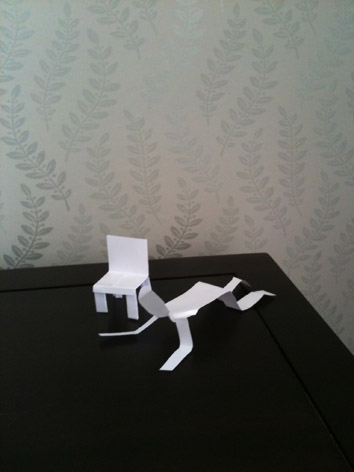
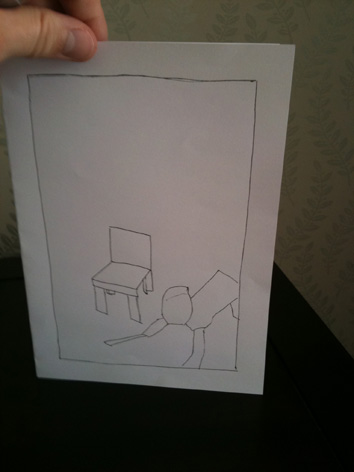
When the audience is prompted to move the frame to the left it reveals a real scale model of the image they had scene in the frame – the model is of 4 yr old Liam listening at the floor and hearing a muffled phone ringing. The audience are instructed to open the top drawer of the unit…
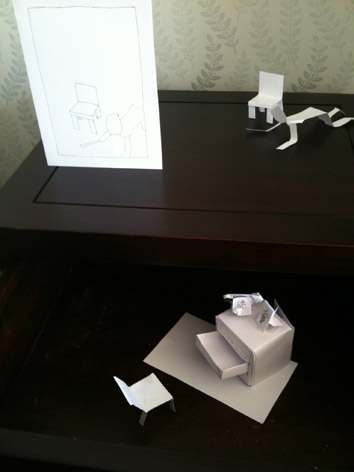
This reveals an exact scale replica of the unit of drawers – as they open the drawer the miniature phone that is ringing gets louder and then stops. The audience hear about this moment when Liam missed a call from his missing father by getting to the phone too late…
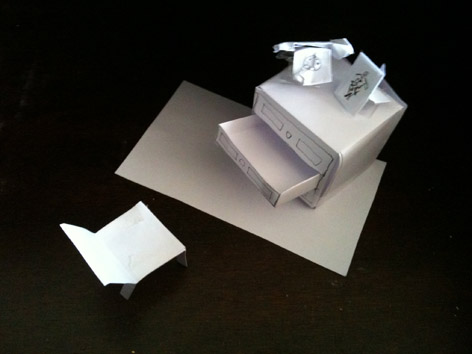
The audience are instructed to take something out of the second drawer (but we’re not yet sure what!) – we think it might be a miniature version of a torch Liam got for Christmas as a child – the audience will then use this torch to pick up the treasure hunt looking for his father through different memories.
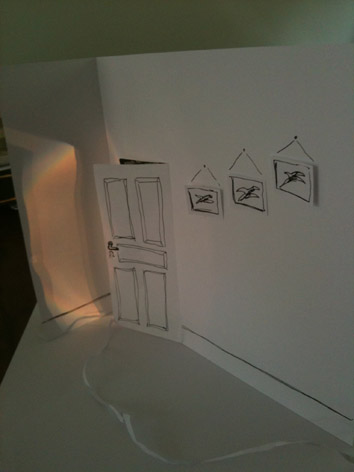
This station concerns a conversation on the phone overheard through a half open door
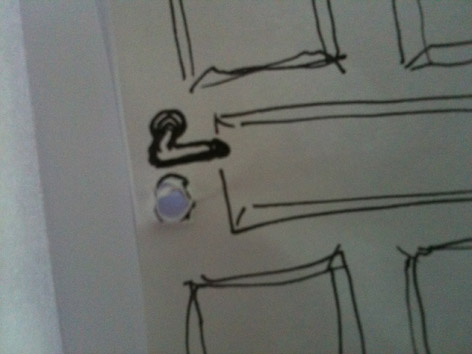
At this station the audience may be able to look through a keyhole in the door which reveals another part of the memory on the other side
Next week we are meeting with Kenton O’Hara, Sharam Izadi and his colleagues at Microsoft Labs on Tuesday 3rd August – this trip will serve to further define what pervasive media we can use to shape the journey for the audience. We now know that we are looking for a triggering system which can be used to both instruct our audience within the experience but also give them insights into each station. Eg. They peel back wallpaper in the model and a recording/projection is emitted to give clues as to something that might be happening in a telephone call on the other side of the wall.
We have also gained ground on the overall narrative. Charlie Kaufman has become a dominant influence in that the audience, by participating in this experience, are being invited into the mind of Liam Jarvis. They embody Liam as a 4 year old and partake in the search for his father after receiving a phone-call alerting them to a final half-remembered letter that sends them on their way through each memory. With each new station they, like the young Liam, learn about what came before, exacting what they can from the incomplete clues that we offer, until the final station sees them sit with the adult Liam to model their final chapter of the story and perhaps draft a letter to their 4 year old selves.
You may notice that some ideas, in particular those relating to the revelation of Liam at the real site, have taken a back seat. Increasingly, this idea has become impractical and in fact was not proving to have impact enough to be worth further exploration.
We have set ourselves the goal of completing the full journey by the end of this week. As part of that, we aim to have a firm and clear understanding of what we want to evoke at each station in order to approach experts for advice on a more sophisticated execution of audience interaction using pervasive media next week.
You’ll know on Monday if we successfully reach these targets!
It’s been good to keep in touch with other projects via the blogs – looking forward to hearing more next week.



Comments