Projects 2010 > Living Film Set > Journal
Welcome!
Hello – Welcome to Analogue’s first blog documenting the process of our Theatre Sandbox commission. Over the coming months we are actively using this web space to share the journey of the project with you. This includes information about our working methodologies, a mental map of how our work is evolving, our most pressing concerns, our successes and our failures (however exposing they may be!).
The Project…
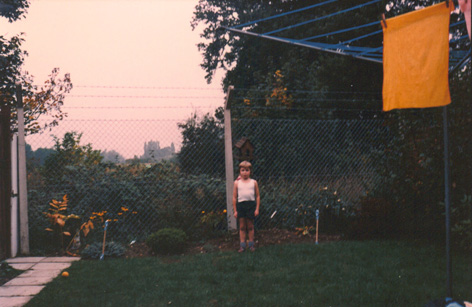
(Pictured: Liam in the garden in 1985)
Before discussing the events of the last 2 weeks of research, let me first revisit our initial pitch and briefly explain our project…
‘Living Film Set’ is an investigation into reframing autobiographical semi-remembered events as an interactive experience for an audience. The specific time period that is forming the basis for our research is May 1985, the year my father vanished. I was four years old and my mother, my sister and I left our family home near Reading to live with my grandparents in a small terraced house on a council estate in Shepperton, Surrey. This house was built in 1977 as part of a high density housing development on the old Sound City lot of the Shepperton Film Studios which was sold off to rescue the studios from the threat of closure. In a very real sense, I lived on a film set in which the world of fiction would regularly superimpose itself on the world of my childhood.
In practical terms, we want to create an experience in which the spectator navigates through a maze of micro maquettes and to-scale film sets of the interior of my home in 1985 (reconstructed through old photographs, documentary evidence and fallible remembrance). The journey the spectator will make is that of a 4 year old child searching for his missing father at 6 different stations (each ’station’ representing a significant moment surrounding my father’s absence). Using the language of film sets, the spectator will peer through miniature half closed doors, listening in on phone conversations through walls etc. We anticipate finding ways of using pervasive technology to allow interactions with the maquettes, triggering visual, kinaesthetic or auditory mnemonics (such as recordings of remembered conversations, related clips from films created in Shepperton during 1985), but also to trigger things at the real site (finding ways in which interactions with the model can have causal implications in the real site).
The Process…
We have undertaken a number of research exercises these last 2 weeks, with a view to extracting content and prioritising memories that are most significant before making decisions in regard to form, structure and the specific technologies we will be implementing. We also visited The Junction, Cambridge (our host venue) where Kate kindly gave us a tour of the space where the work-in-progress performance will be happening on 29th September, 2010.
We have devoted the first week of our time primarily to research in the form of site visits, personal interviews as well as secondary research. We have looked through a variety of research ephemera such as old photographs from my childhood, letters, school books, toys and uncovered an audio cassette recording made by me as a 3 year old, my sister, my mother and my father in 1984 (the only surviving audio documentation from that period in my family – clips of which will appear in the performance itself). Most of these items were discovered in sealed cardboard boxes in my mother’s loft, many of which have not been opened in over a decade.
On Wednesday 7th July we conducted a site visit to the estate where I grew up in Shepperton. This is the first time I have visited in 19 years. Whilst at the site, Hannah conducted a series of short interviews with me and we took a number of photographs, audio and videos recordings.
Subsequent to this visit, we set ourselves the exercise of creating a series of paper models/installations to visually represent the memories that were evoked from the visit, providing a caption for each one.
Here are some of the models that we created:
‘After ‘the phone call’: A mother crying on the hallway stairs, and a brother in a sister’s arms’
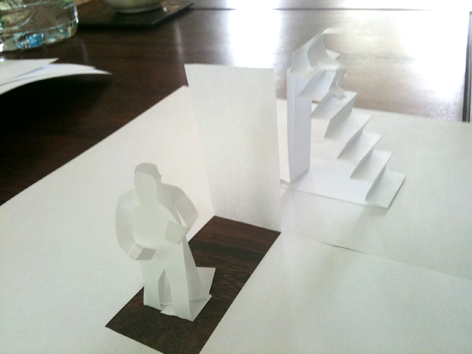
‘Father carrying a son through a gap in his own ’goodbye’ letter’
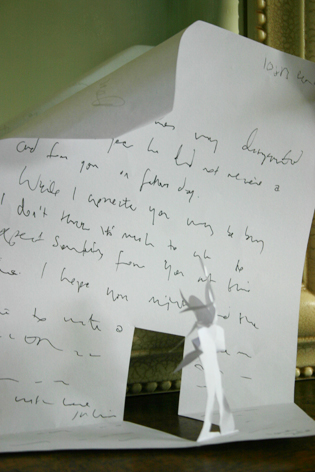
‘Playing Scalextrics in a shed in the garden; he won, I lost’
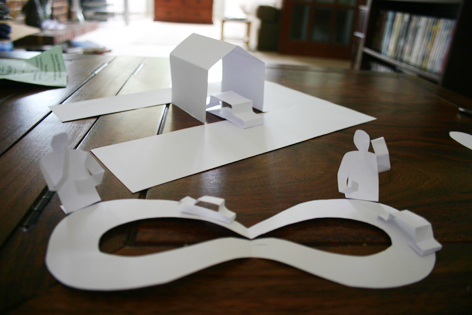
‘Leaving home: The car full of all our things. A mother crying in the front passenger seat. A son in the back, hugging a knitted pirate’
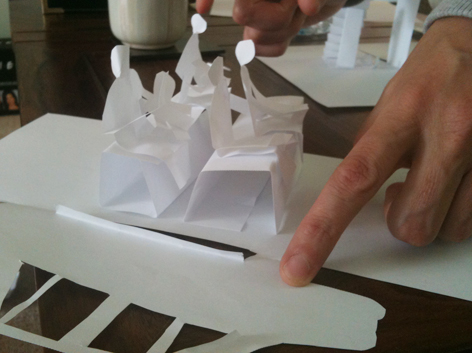
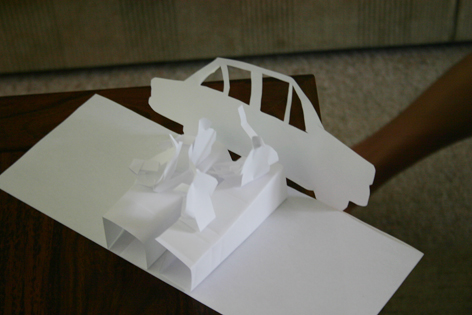
‘Dad leaving: A glamorous woman turns and waves at us from his car. He starts the engine. He doesn’t turn back’
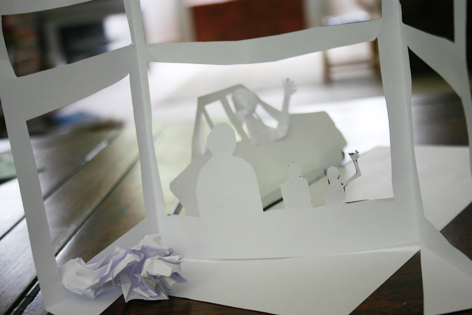
‘Playing with scale: Hannah at the door’
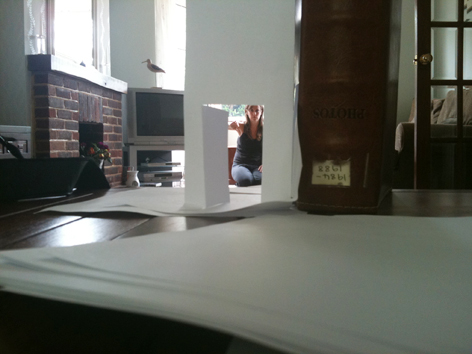
We are interested in exploring ways of integrating the low-fi with the high-fi; how might pervasive technology integrate with models or a low-fi kindergarten arts and crafts aesthetic? What is the limit of interactions between the audience and scale models? What does varying ’scale’ signify? – is a small model something that is more distantly remembered? Is it possible to project a miniature live video feed of a person into a model and for them and the spectator to interact? These are basic questions that are emerging from our initial discussions.
In terms of secondary research, as part of our introduction at Pervasive Media Studio on 1st & 2nd July we had the opportunity to experience ’The Magician’s Desk’, a fascinating performance experiment presented by resident artist at the Studio, Mercurial Wrestler. This experience has raised further questions in terms of how best to create a journey for an audience; in what ways might the audience navigate through sequential triggers/instructions? What’s the ‘treasure’ at the end of this treasure hunt? How might we anticipate particular audience responses (indeed, can we anticipate particular responses?!)? What experience can we create for an audience with the technology that couldn’t be achieved without it?
The next step for us is to begin drafting a storyboard of the journey between each of the 6 stations, to consider what different interactions take place at each station and start seeking the technical expertise to begin discerning what is possible with the resources we have and in the given timescale.
I’ve merely scratched the surface here, but Hannah and I will continually return to this blog to update you on our current thinking and explain our decisions as they unfold. We really hope you will track the journey of the project (and please feel free to comment!).
If you would like to know more about the company and what we do, please visit our website. You can also receive company updates by following us on Facebook & Twitter.
More to come very soon – best, Liam (and Hannah)