

Victoria Tillotson Head of Talent Development
on Tue 13 OctThe Future is Interdisciplinary: Reimagining How Young People Access the Creative Technology Sector
Posted on Tue 13 Oct
This article reflects on Watershed's work with young people by exploring how they can access opportunities in the sector and also launches 'Making the World Differently', a report by Frazer Meakin, who spent ten months as a MyWorld Fellow.
The Best Feeling in The World
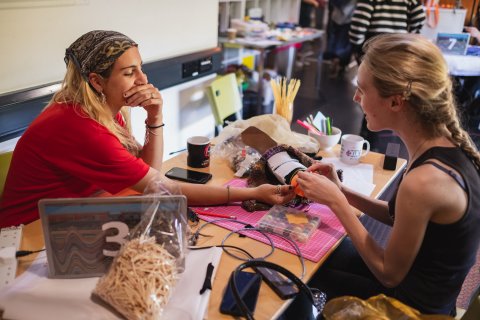
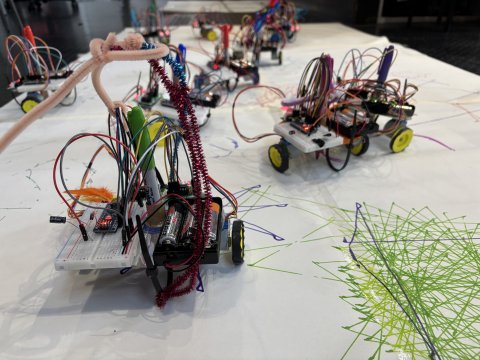
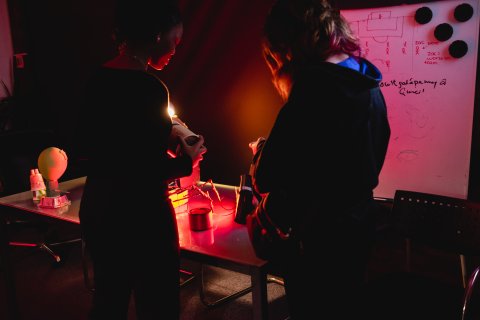
It's the last week of June. A group of teenagers are making a soft robotic snake, testing how tubes and computer-controlled motors can make it move. Nearby, another group are discussing how to build a robot that captures the feeling of snoozing and warmth, and then they set about making it, working out the approach and who will do what. Across the table, someone else is playing with lighting, thinking about the atmosphere around their robot and how an audience might experience it.
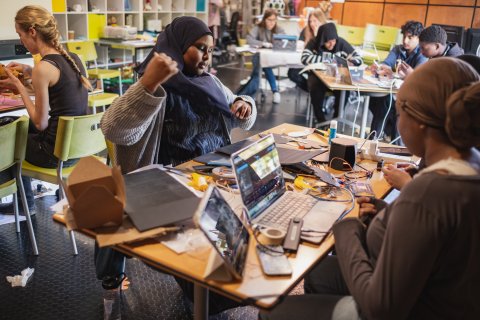
All of this happened this summer at Watershed's Pervasive Media Studio, where 30 young people from schools and homeschools across Bristol spent two Work Experience weeks making animatronic artworks on the theme of 'the best feeling in the world'. Students were not recruited to be assigned to the art side or the tech side of project development. They brought a mix of skills and their personal interests and used these together to make work.
Mixing skills and knowledge across subject areas isn't how most young people in the UK spend their school week. Art happens in one room and computer science in another, and the two rarely cross over. There are understandable reasons why this structure has taken hold. Individual timetables for hundreds of students must be built, and subjects need boundaries to be well taught. But it does create a gap between how young people are taught, (to think about subjects as separate) and how the industries they might join actually operate, which is far more interdisciplinary.
This gap is the subject of a new report, Making The World Differently by Frazer Meakin, commissioned by MyWorld in partnership with Watershed and the University of Bristol. The report explores what skills and training opportunities young people need for a career in creative technology. Watershed co-commissioned the work because we wanted to refresh our knowledge and strengthen our long-term work bridging together education, industry and where young people are at. Frazer’s findings have been incredibly useful.
The Wider Context
In Making The World Differently, Frazer highlights the World Economic Forum's (WEF) Future of Jobs report, which "underscores the importance of creativity and problem-solving as transferable skills beyond specialist subject areas." He notes that:
"In the face of rapid technological change and global complexity, the ability to connect ideas across disciplines, think creatively, and adapt quickly is no longer optional - it is essential."
Watershed has been working this way for a long time. When we set up the Studio in 2008, we drew on a concept called ‘Creation Nets’ developed in 2006 by John Hagel III and John Seely Brown. They argued that the most valuable innovation was increasingly happening across loosely connected networks of artists, technologists and organisations (rather than in single companies), brokered by someone whose job it was to make the right connections rather than control the outcomes. That's more or less been the Studio's model ever since. Run in partnership with UWE Bristol and the University of Bristol, the Studio isn’t a programme with a fixed brief, but an open space where over 200 artists, technologists and academics from different disciplines and organisations work alongside each other, with Watershed acting as a convener rather than an owner of what is made. Cross-disciplinary work has been at the heart of our practice for all that time, and it is fantastic to see it recognised in both Frazer’s and the WEF report.
We have always worked hard to bring young people into this practice, and this feels increasingly important in the context of Artificial Intelligence (AI). The technology is developing fast and changing how work is done. Young people have told us they are worried it will reduce their opportunities, but we already know that AI cannot easily automate the nuance at the meeting point of art, design, empathy, ethics and technical development. We think this nuance is still very human-centric. It's the bit where someone decides what a thing should feel like and then works out how to create it. This is in fact, what our group of teenagers were doing when they tried to make a soft robot look like it was snoozing.
Elsewhere in the report Frazer describes young people's strengths. He found creative thinking was consistently strong across the groups he worked with, but there were some gaps when it came to resilience. He notes that school tends to break tasks into manageable pieces, which helps with learning but doesn't quite resemble how a real project goes wrong and gets fixed. Undertaking open-ended making at Watershed in the context of the Studio is a wonderful chance for young people to practice this key skill, building on the important work that schools do.
What Frazer’s Report Recommends
Frazer's report considers how the creative technology and education sectors can collaborate better, including how work experience can be a real developmental opportunity, and what families can do to support young people into the sector. Some of his recommendations map very closely onto things Watershed has been doing for years.
More Interdisciplinary Practice: Ask schools to create environments where technical and creative thinking develop together rather than in separate rooms. Up until now, this has been tricky for schools to prioritise. In 2010 the previous Government introduced the English Baccalaureate (EBacc), a performance measure built around a set of core subjects that didn't include the arts. According to the Cultural Learning Alliance (2024), GCSE art entries fell by over 40% as a result, and arts teacher numbers by 27%. It also signalled to parents and young people that creative subjects were economically risky and intellectually lesser. The EBacc was abolished following a review in 2025, so there's now an opportunity to restore arts provision with interdisciplinary practice built in. It's something Watershed is well placed to help with.
Our Work Experience programme, that has run for 12 years, already models this sort of cross-subject approach. The student team building the snoozing robot needed engineering to make it move, sound to make it breathe, lighting to create the atmosphere, storytelling to ensure the audience understood it was snoozing. Across the week, the group drew on arts, humanities, computer science, design technology, maths, English and science to successfully bring their ideas to life.
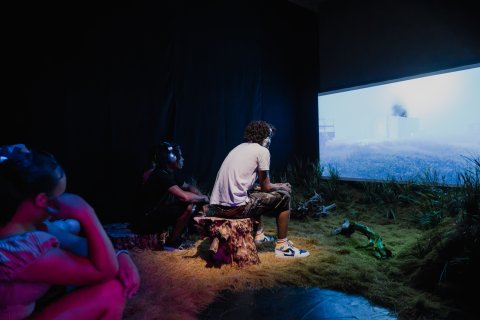
Introducing people into the world of interdisciplinary creative technology practice happens in other parts of Watershed too. Our Undershed gallery, one of a handful of UK spaces dedicated to interactive and immersive art, recently showed SENTIENTS, an exhibition of artists' video games inviting audiences to experience the world through another perspective, an owl, a dog, a climate-altered Los Angeles. The show was co-curated with a group of Young Curators from across Bristol. The exhibition reflected their ideas, sharing themes and artworks that resonated strongly for them. Curating an exhibition in this way enabled our group to draw together skills in research, critical judgement, design, storytelling, audience development and collaboration, working with international artists and our team to make something truly magical happen.
Reimagining Work Experience: Traditional models often include students watching from the sidelines or completing isolated tasks which can leave young people frustrated, “young people hungry for real experience, employers overwhelmed and ill-equipped to provide it.” Frazer argues for treating it as a two-way street, where the young person absorbs how a workplace thinks, and the professional gets something back by reflecting on their own practice.
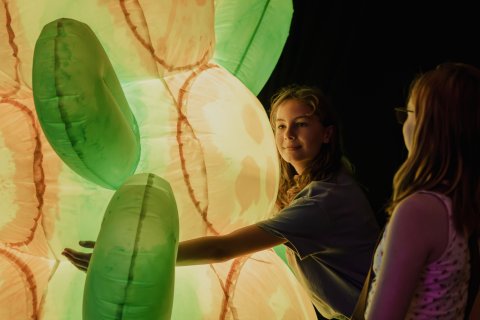
This is a close description of what happens when young people work at Watershed. Our teenagers definitely don’t shadow quietly from a corner. They make noise, they take up space. This summer they also worked alongside Eleanor Edwards, a brilliant creative technologist and Studio Resident (who joined us in 2024 through our young people’s programmes), and Air Giants, a Bristol-based creative studio who make giant inflatable soft robots that tour internationally. Air Giants use the same computer-controlled motors as the students did, to get initial ideas off the ground. The students experienced a real-world, Air Giants ideation process, and Air Giants reflected on their process through inviting students into it. Two of the Gatsby Benchmarks, the framework UK schools are required to work towards for careers guidance, are specifically about employer encounters and workplace experience. Watershed’s work with young people, is a great example of what meeting these benchmarks can look like.
Language and Geographical Access: One of the more unexpected findings in Frazer's report is about language. Working directly with young people across Bristol, he found that ‘creative technology’ as a term often feels vague, distant, something other people do, particularly for those from under-represented or lower-socioeconomic backgrounds. Frazer notes that opening a door only helps if someone can see it's there.
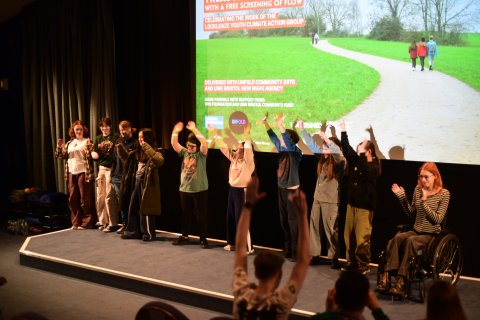
We are massively aware that there is a geographical element to this in Bristol. With a few brilliant exceptions like Knowle West Media Centre, creative technology opportunity in our city tends to sit in the centre, around Harbourside, Temple Quarter and Stokes Croft. For young people in for example Lawrence Weston, Hartcliffe, Southmead, Lockleaze etc., getting to Watershed or other businesses in the area, means travel, cost and already knowing the opportunity exists. Watershed has a fantastic network of schools and partners in the city that we work with to encourage and support young people to connect into opportunities – our partnership with Lockleaze Neighbourhood Trust, Unfold Community Arts and UWE Bristol exploring sustainability, storytelling and film to share a powerful message is a brilliant example. However, there is still a gap in supporting young people to travel. Schemes like free bus travel for young people in school holidays is great, but extending this into periods of term time for schools, would unlock a myriad of opportunities for young people.
What Next
In 2025/26, 2,230 young people took part in Watershed’s skills development programmes, and a further 39,416 came to screenings and events. Some will have spent time in the Studio on Work Experience. Others will have joined our family workshops or popped into Undershed to see artwork the Young Curators chose. Quite a number stay connected for years, running their own businesses, working for others, or operating as freelance practitioners. Some come through Make Shift Camp, our lab week for early-stage creatives, or Make Shift Come Unstuck, our monthly peer support sessions, or BFI Film Academy our year-round programme for 16–25 year olds. We offer numbers of ways in, because no two paths look the same and people need different kinds of support.
In 2025, Bristol City Council estimated that our city is home to approximately 164,743 young people and roughly 21,000 children from underserved backgrounds. No single organisation can reach that many people alone. This is why we believe in being part of an ecology of support bringing together arts, culture, education, communities and industry, to work collaboratively rather than competitively. A teacher who dropped into our Work Experience in the Pervasive Media Studio this summer commented that it was wonderful to see that their student hadn't been tucked into a corner to work alone. They were making, sharing and talking with practitioners from across sectors, properly part of the community.
We have spent years building the kind of space where this happens naturally and we feel really strongly that we need to look after it, as it will only become more relevant as we move into the future. The skills Frazer’s report highlights such as resilience, creative thinking, problem-solving, connecting ideas across disciplines, are best learnt by working alongside people who already think that way. This is what a convener does, and what Watershed has done since the Studio's earliest days. In Bristol, the creative technology pipeline doesn't need wholly reimagining, it needs resource, support and love to continue.