

Tony Bhajam Inclusion Producer
on Thu 15 OctMaking Work and Shifting Practice at Watershed
Posted on Thu 15 Oct
Reflections on a summer of Talent Development programming in Pervasive Media Studio from Inclusion Producer, Tony Bhajam.
As a little chill has set into the air, I have been reflecting on some of my personal highlights throughout a summer of young people’s projects and workshops at Watershed in the Pervasive Media Studio. Two of those highlights are undoubtedly our joyous annual Work Experience programme, and the equally joyous Make Shift Camp.
This is all very timely as we've just launched Making the World Differently, a report that looks into skills development and employability for young people. More than ever, I am convinced that if we give young people space and access to expertise, they can and will achieve great things.
We kicked off the summer with a question: What is the best feeling in the world?
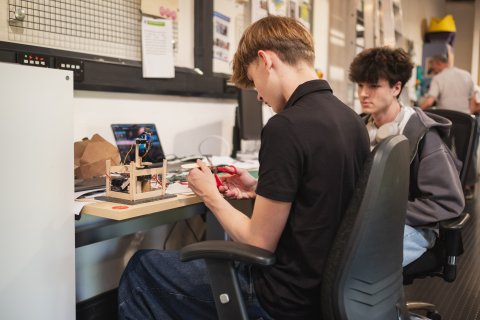
Our Work Experience programme is not your standard envelope stuffing exercise; over the last 4 years the team have refined a student-led 5 day programme which immerses them in quick-fire prototyping processes which are so central to creative industries. Every year, we host 2 cohorts of 15 students over 5 days with 15-16 year-olds, and 5 days with 17-18 year-olds, from schools and colleges around Bristol.
In one week, we invite them to imagine and build early-stage prototypes in response to a creative brief.
Our Talent Development team at Watershed has built a network of schools and colleges from around Bristol, and our cohorts reflect the make-up of the city, bringing together students from different backgrounds, with different experience and varied skills and interests.
Each week started with a big question: What is the best feeling in the world?
Our teams then shared rich stories about themselves and their worlds.This was all part of a creative brief set by us, in partnership with Air Giants, a Bristol based organisation making huge, emotionally expressive, soft, robotic creatures and spaces. The challenge was to design, iterate and develop a prototype for a robotic being or creature, using a process developed by Richard and his team that they call 'dreaming'.
'Dreaming' starts by exploring those powerful moments and feelings we all experience, sharing stories and ideas to find common ground. We then explored how movement conveys feeling and considered who or what might express those feelings best. The teams then translated those movements into robotics software and hardware, building prototypes of moving characters that the teams shared at the end of the week.
Our teams shared prototypes of grumpy gremlins, sleeping hedgehogs and a penguin going on holiday, amongst so many other amazing projects.
Early in the week we talked about dream jobs and career plans, and it was so great to be able to spend time with future stop-motion movie designers, cosmologists, philosophers, barristers, stage and set designers, film directors, scientists, engineers, NGO workers, lawyers, programmers, games designers, accountants and economic engineers. The young people of Bristol have big plans, and I love to see it, but I also couldn’t ignore the inflection of uncertainty in their voices. Talking about careers and thinking big did not come easily to everyone and being certain of the path to get there even less so.
“[Going forward] I will talk to more people about job experiences"
- Work Experience Participant 2026
University education didn’t feel like the panacea it might have done ten - even five - years ago. Dreaming about futures came with concerns about future earnings potentials, all with the spectre of ‘AI taking jobs’ looming over people.
I also note that one of the biggest challenges the facilitation team faced was convincing students to lean into failing fast. Our education system is not providing space for young people to get things wrong, to not always build towards clearly defined outputs, or to have all the answers.
This process of trying, adapting, and moving on is so integral to the way creatives work and the future of Bristol’s ecosystem of artists, technologists and researchers depend on it. Sadly, opportunities for future technologists to hone those skills are rare, which is why we are so sure things like our Work Experience programme are so important.
“[I learnt that] It's ok to not be perfect."
- Work Experience Participant 2026
We rounded off the summer with another question: What could a video game be without the video?
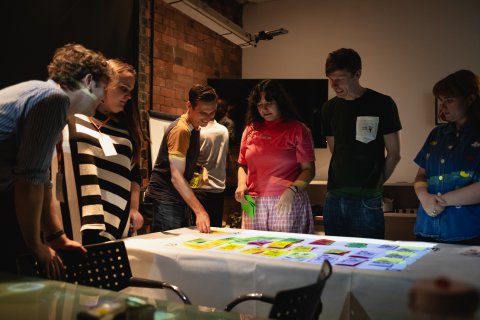
In August, we hosted the fourth annual Make Shift Camp. It brings together eight artists, technologists, and practitioners, aged 18-30(ish), to respond to a given theme and to produce working functional early-stage prototypes in five days.
This year’s Make Shift Camp theme was video-less games. Taking inspiration from Undershed's summer exhibition SENTIENTS, in which artists subverted game practices, we asked “What if you could control a game with your shadow, your breath, or the weight of a stone?” and invited campers to bring together code and cable ties and pixels and poster boards.
Early on in the week, we got into the deep stuff, exploring definitions of games, questioned what it means to have an inherently joyous experience, what counts as an art form, and what it means to have agency. We also had loads of fun conjuring up ideas for projects involving huge, oversized hands, a trip to Barbados, and something about selling animals on the stock market that I never quite got to the bottom of.
At the start of the week, we all shared some hopes and fears for our time together. Our hopes spoke of wanting to connect, share, meet and be in community, a sentiment which echoes so deeply across our wider Studio Community, and feels so pertinent when we think about the world at large now.
Our fears also echoed conversations I have had a million times, fears about not being good enough or our ideas being clever enough. People worried about the skills they have, or rather the better skills someone else might have, and the all-consuming imposter syndrome, all of which will feel so familiar to anyone who has ever experienced collaborative working or being new to a space and a community.
"My initial motivation was that it sounded fun, like a hack week. I am a software developer and I was looking for something more creative and physical...Being involved in the creative process in the camp to build this prototype made me realise that I may not want to apply myself purely to software development but to the wider creative product development process."
- Make Shift Camper
During the application process, one of our campers reflected on never having the space or time to just think things through, to try things and get them wrong, and to do it in community, and they are so right.
"This creative method of rapid prototyping focusing on more open exploration rather than just problem solving is really interesting and useful because I am not focusing on what it is going to be in the end, but rather the process. It gives you a broader field of possible things you could make."
- Make Shift Camper
The teams produced some brilliant work; a bear-building social deduction game, a fast paced data race against billionaires and data centres, a puzzle solving game based in a human language academy. They showed their prototypes to a public audience at our First Friday networking events in September and October.
Previous Campers have stuck around as Studio Residents and in our wider community, but have also committed to work together, to collaborate and to build new things. Some have gone into new fields and new jobs near and far. I really hope the same is true of this year’s lovely bunch.
Thanks to all of our Campers for taking part!
Taking Leaps of Faith and Exploring Newness
At the core of the challenge we set out across both programmes is an invitation to explore what it means to collaborate, to collide ideas, and to embody some of the ways of working which are so fundamental to how our Pervasive Media Studio community bring together practises, skills and energy, smashing together ideas to build new things.
We ask teams to get to know a new environment, new people, and to engage in whole new fields and practices. We ask them to learn new hardware and software, and to develop new artistic practices and creative ideas, and to grow those ideas into tangible projects. ALL within the space of 5 days!
We ask them to go along with new art and design processes which aren’t their own, or their usual one at least, and to do things that might be out of their comfort zones, where it’s not always readily apparent what might come of things.
I think the biggest challenge of all is that we ask them to take a leap of faith with us, and to trust that all of this will end at something that they could be proud of. And proud they should be.
This invite to newness is no small thing. In bringing together truly diverse cohorts encompassing both lived and professional experience, and in centring the exploration of collaborative practice in this way, both programmes encourage participants to interrogate how we encounter newness, and each other.
This supports our cohorts in making space for difference, and to demonstrate how we make things better when we make them together.
The report launched earlier this week is called Making the World Differently and experience has taught us that designing programmes in this way feels so central to achieving that.
“The opportunity to flow and collaborate in this way with a group of other creatives really makes it easy to imagine working across disciplines because I have done it. It feels like there is a strong chance that I will collaborate with some of the other participants in the future. The early ways of working have already been established as part of the Camp as well as the building of trust between us as practitioners, which tends to be the tricky part of collaborations.”
- Make Shift Camper
Looking Towards New Year
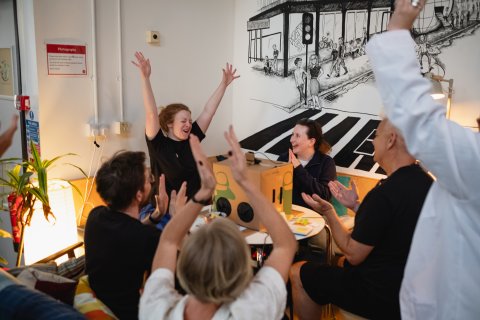
As I think back across the Camp and Work Experience, I’m struck by how important they are, in conversation with each other.
Work Experience carves out space for young people to explore creative careers and build those all-important soft skills, similarly Make Shift Camp seeks to support young people as they develop their creative practice, grow their creative communities, and explore what it truly means to collaborate.
Supporting and guiding young people in these two key areas as they try on new hats and visions of their own futures is so vital to a generation of young people finding their place in the wider creative industries ecology of the city.
This has established a practice of interrogating and subverting wider themes and ideas currently being explored in Pervasive Media Studio, carving out a space to play with ideas that can feel quite big or heavy but with an irreverent flourish.
Nevertheless, opportunities like these are rare.
Both this year’s Camp and Work Experience were largely funded by MyWorld with support from the Nisbet Trust and Arts Council England. Through this funding, we have been able to secure expert facilitation for Work Experience and be able to provide participation bursaries and a resources budget for Camp. This is crucial in allowing Campers who work freelance to give themselves permission to pause the grind, not build to client specs, and let themselves explore their own practice, and to work through the complexities of finding work, career changes and skills development.
It is this wonderful mix of space, time, resource, community and expertise that I think makes these programmes such a success and speaks also to our communities understanding of ‘what it takes to nurture creative futures’, the needs of our wider Studio Community, and Bristol’s creative ecosystem more widely.
As the MyWorld programme draws to a close next year it leaves behind a legacy of skills & training and development opportunities. Makeshift Camp provides a successful design methodology and collaboration framework which carves out pathways for 18 - 30 (ish) olds into creative jobs and establishing a practice, but we will need funding to ensure we can offer this type of support to people.
All of this is to say, I’m already SO excited for what next year’s cohorts will do so roll on summer 2027!
If you are a teacher or student who wants to know more about our 2027 Work Experience programme and Make Shift, or If you are a funder looking to nurture creative talent in Bristol, then please email TalentDevelopment@watershed.co.uk.